How to Solve AppSec Tool Sprawl in 2026
AppSec tool sprawl is rarely a licence problem. Separate SAST, SCA, secret scanning and DAST tools were a rational way to buy detection, but the real cost of that stack is the human work required to hold it together.
At renewal time, the conversation with security leaders almost always starts with the individual tool. Is this scanner good enough? Is that one too noisy? Which one should we add or replace next?
That question misses where the security team's week actually goes.
After more than three years of building security agents at Nullify, we have come to think the multi-tool stack rarely fails because any one scanner is bad.
The stack fails because it is organised around how vulnerabilities are detected, while the work is organised around how risk is decided.
The gap between those two does not disappear. It gets filled by people.
AppSec tool sprawl was a very rational way to buy detection
Each category grew up around a distinct technique. SAST reads source code. SCA reads manifests. Secret scanning looks for credentials. DAST tests the running application. For years the best tool in each came from a different specialist, so buying the best tool for each new gap was sensible.
The problem is not any individual purchase. It is what happens after the third or fourth, when the findings from all of them land on the same small team.
The same risk arrives four times
Detection tools do not share an identity for what they find. Each has its own ID scheme, its own severity scale and its own idea of what "fixed" means.
We have seen a single vulnerable line generate a SAST, an SCA, a secrets and a cloud posture finding at once: four tickets, four pages, and the same developer pinged four times.
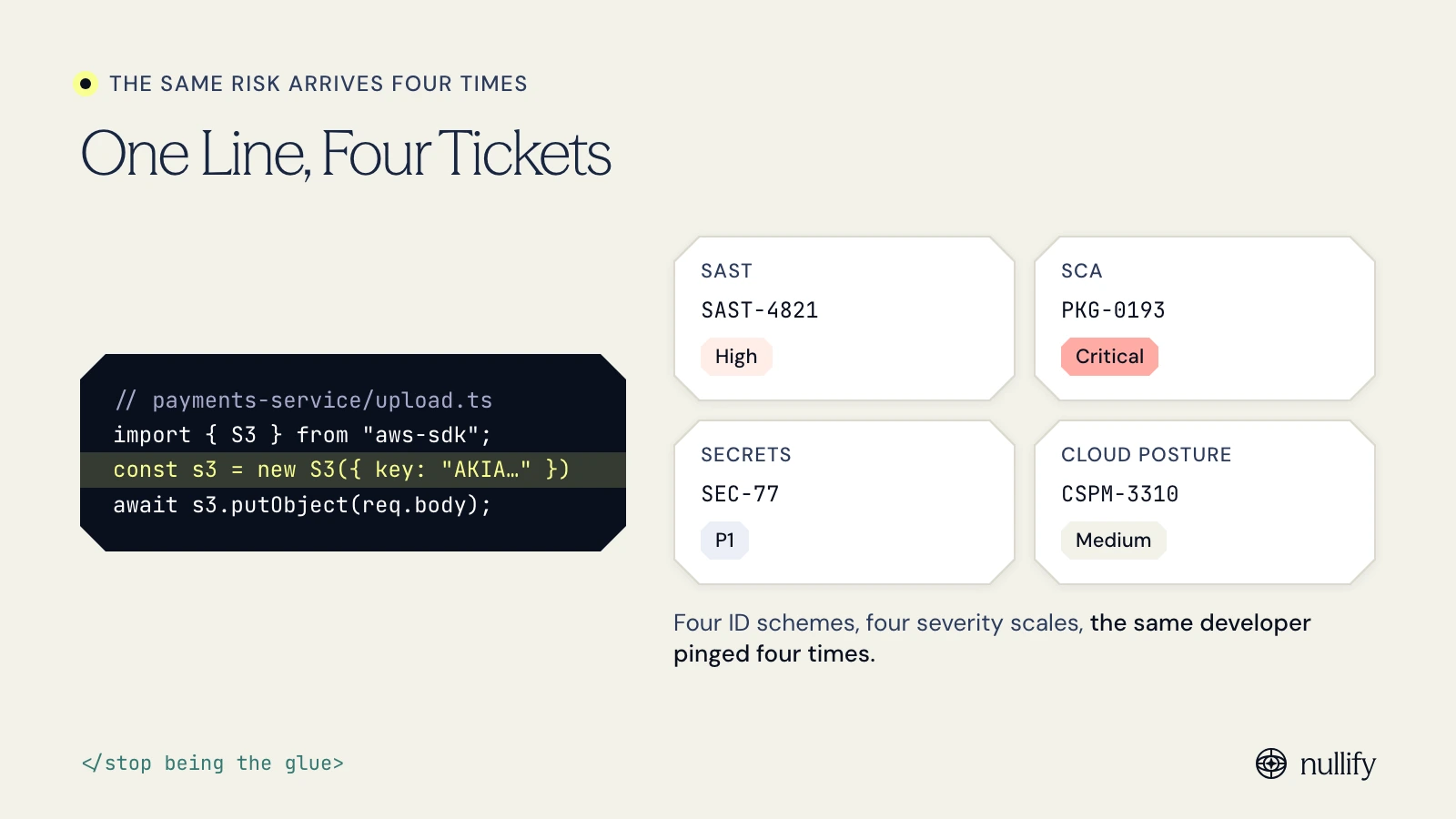
For the developer, that is one issue and three reasons to stop reading security tickets.
The same decision gets made again and again
Each tool also brings its own noise. In one ten-repository engagement, we found 547 false positives against 105 true positives. Five of every six findings were noise.
But deciding whether a finding matters comes down to the same questions no matter which tool raised it:
- Is this code actually deployed?
- Can anything on the internet reach it?
- What data does it touch?
- Who owns it?
A stack of separate tools asks a human to answer those questions once per tool, per finding. The work is duplicated not because the findings are duplicated, but because the context is.
No single tool can see what decides the priority
The facts that change a finding's priority almost never live in the tool that raised it. A SAST tool can tell you a query concatenates untrusted input. It cannot tell you whether that service is internet-facing or handles regulated data.
In one proof-of-value, a library carrying four critical and ten high CVEs triaged out as negligible because it never ran in production. Read in isolation, those were fourteen urgent findings.
In a multi-tool stack, the only place code, cloud and business context meet is in a security engineer's head.
What AppSec tool sprawl really costs: the glue is a job
That is the real operating model of most multi-tool programs. Someone cross-references the cloud console, the CI/CD system and a scanner in three tabs. Someone maintains the spreadsheet mapping GitHub authors to Slack handles. Someone re-enters findings into the vulnerability-management platform and reconciles statuses between tools.
None of that is security judgement. It is clerical work done by people with security job titles, and it grows with every repository, team, cloud account and tool. To measure it, split last week's security hours into judgement (is this real, reachable, important?) and glue (linking, routing, re-entering). The second bucket is usually uncomfortably large.
Much of it is recoverable. When we re-ran ownership resolution across production tenants, one customer's backlog went from more than 90% unowned to roughly 35%, purely by reading CODEOWNERS and team data they already had. None of their tools were reading it.
The licences are the price of detection. The glue is the price of the stack.
What changes when detection shares one graph
Nullify is built to remove the need for a person to be the join between tools.
One identity for every finding. Nullify runs detection across SAST, SCA, secrets, containers, cloud posture and dynamic API testing. Every finding lands on a single asset graph, linked to its repository, image and infrastructure. Four tickets become one connected piece of risk.
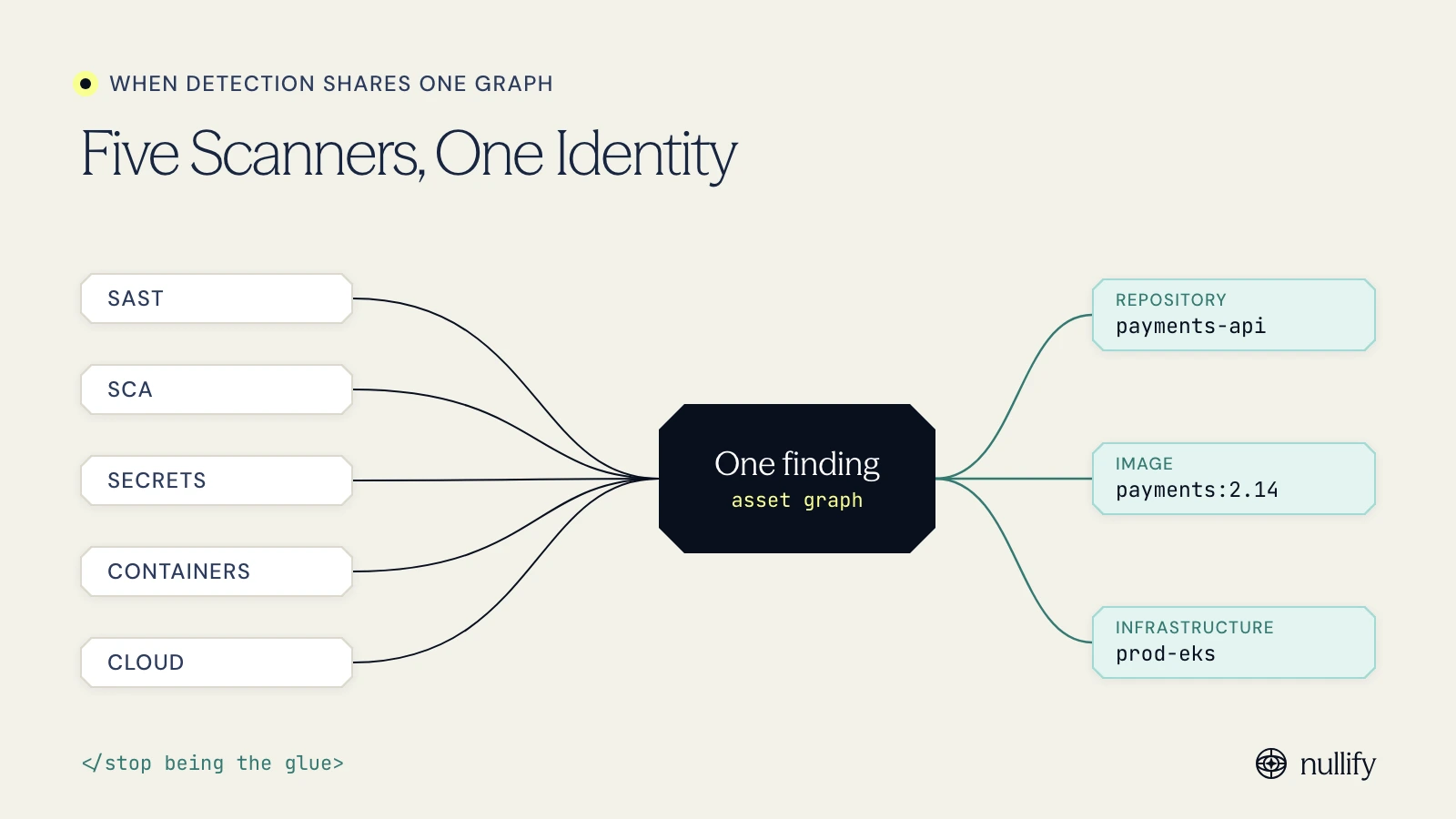
Context read once. Triage agents reason over that graph, including internet reachability, and over Vault, which holds the organisation's architecture, policies and internal knowledge. The questions answered tool by tool are answered once, with evidence attached.
Execution without the clerical layer. Validated findings become merge-ready fix PRs in GitHub, GitLab or Buildkite. Campaigns route work to the right owner, track it against SLA and verify it is fixed.
The wrong takeaway is "consolidate to cut licence spend"
The wrong takeaway would be to rip out every specialist tool tomorrow to shrink the licence bill.
Detection quality still matters, and a platform that finds less is not an improvement. Moving from four tools to one with the same triage burden only changes who sends the invoice. That is why Nullify writes into the tools of record teams already run instead of demanding they be replaced on day one. Consolidation should be earned, not demanded.
What matters is how many times the same decision is made by a person. The security team still defines what matters. The difference is that its judgement is applied once, instead of being rebuilt in every tool.
The real question is who is holding the stack together
The better question is: who in your organisation is acting as the integration between your tools, and what would they do with that time back?
For most teams, the honest answer is the security team itself.
Stop being the glue.